
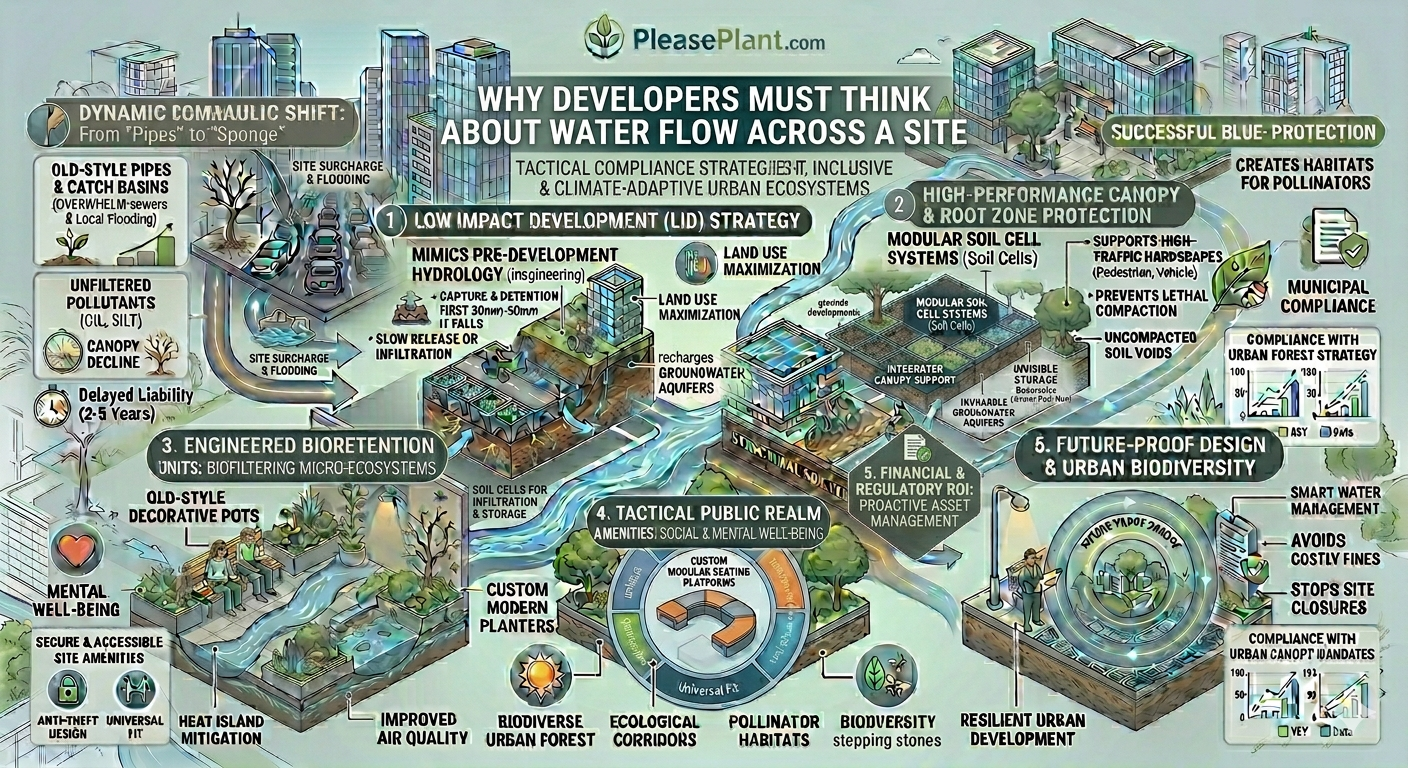
Why Developers Must Think About Water Flow Across a Site
In the natural landscapes of British Columbia, water follows the path of least resistance, soaking
into the forest floor or trickling into local streams. However, the moment a developer breaks
ground in Surrey, Langley, or Abbotsford, that natural rhythm is broken. By introducing
rooftops, asphalt, and concrete, we create "speedways" for rainwater. Understanding site water
management BC isn't just a technical requirement—it is a fundamental part of protecting the
long-term integrity of a development.
The Physics of Developed Land
The real issue developers face is that water is a powerful force of nature. When we replace a
permeable field with an impervious structure, we create three distinct problems for stormwater
flow design:
1. Velocity: Water moves much faster over concrete than it does over grass, increasing the risk of
erosion at the discharge points.
2. Volume: Without soil to soak up the rain, 100% of the precipitation becomes runoff, potentially
overwhelming the property’s development drainage systems.
3. Direction: Water will find any low point. If that low point happens to be a building foundation or
a basement entrance, the results are catastrophic.
The Consequences of Poor Urban Drainage Planning
Anyone who has worked on a development in the Fraser Valley knows one thing: rain will
always win if you ignore it. If urban drainage planning is an afterthought, the site will
eventually suffer from:
• Hydrostatic Pressure: Water building up behind retaining walls or against foundations can lead
to structural cracks and persistent leaks.
• Hardscape Undermining: Improperly directed water can wash away the sub-base of parking lots
and sidewalks, leading to "pothole" failures and shifting pavers.
• Legal and Municipal Conflict: Improperly managed flow that impacts neighboring properties or
municipal infrastructure in Chilliwack can result in heavy fines and lawsuits.
Designing for a "Sponge" Effect
Modern site water management BC focuses on slowing water down. Instead of just "piping it
away," high-performance development drainage systems use a layered approach:
• Catchment: Using permeable surfaces and green roofs to reduce the initial volume of runoff.
• Conveyance: Designing grades and swales that guide water safely away from structures.
• Detention: Utilizing modular underground storage cells to hold peak volumes and release them
slowly into the city grid.
The Designer’s Perspective: Working with the Grade
From an A&D standpoint, the goal is to make the water flow feel intentional. By integrating
drainage into the initial site topography, we can create functional landscapes—like rain
gardens—that handle water responsibly while adding aesthetic value to the project.
Conclusion
Water flow is the "unseen architect" of every development. By prioritizing professional site
water management BC early in the process, developers ensure their projects are safe,
compliant, and built to withstand the unique climate of the West Coast.
To see how our modular drainage and detention solutions can help you master the flow on your
next site, contact Please Plant.