
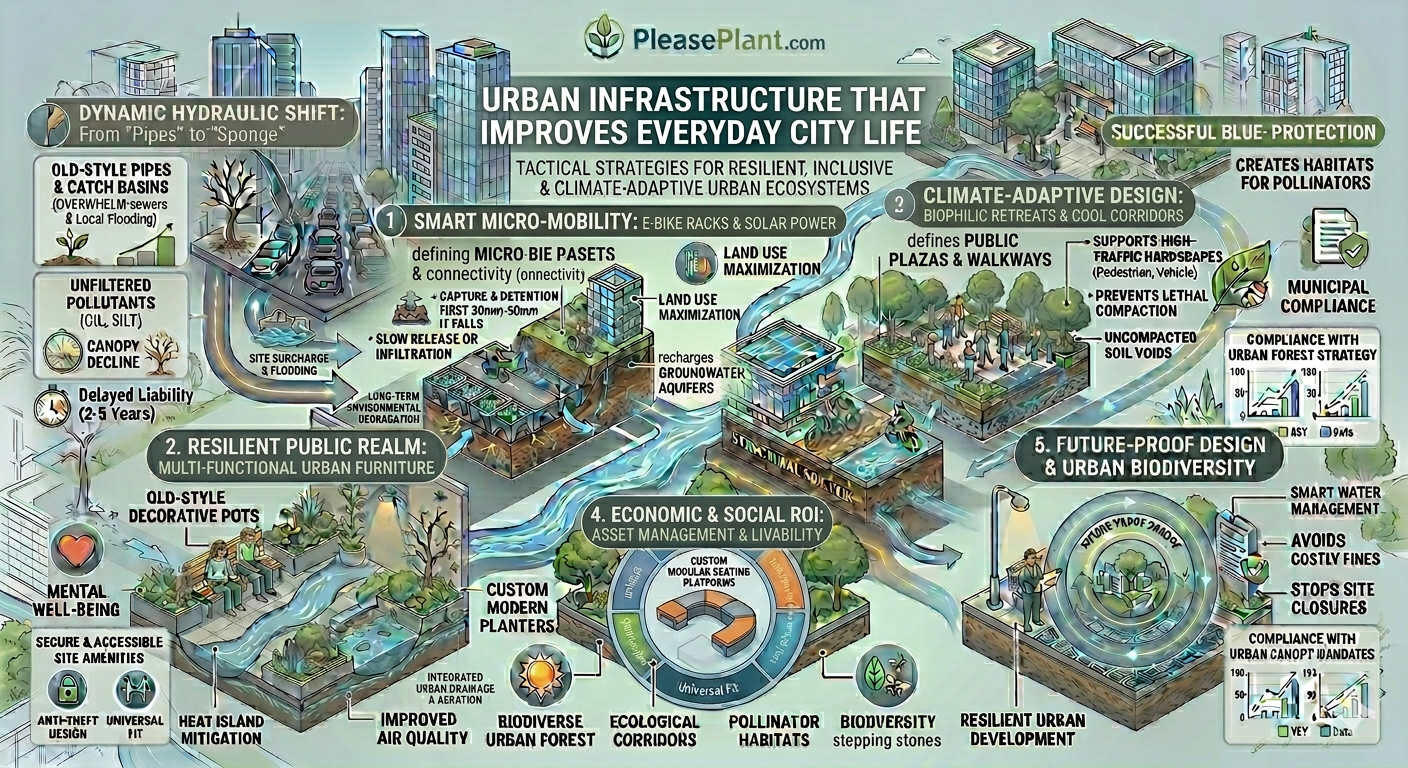
Urban Infrastructure That Improves Everyday City Life
When we discuss urban infrastructure design, the conversation often gravitates toward "mega-
projects"—highway expansions, bridge replacements, or new transit lines. While these are the
arteries of our cities, the heartbeat is found in much smaller details. In Vancouver, Surrey, and
Abbotsford, the quality of everyday life is dictated by the "human-scale" infrastructure we
interact with every time we leave our front doors. Benches, planters, and bike racks are the
building blocks of a city that feels like a community rather than just a grid.
The Power of "Small" Infrastructure
The goal of modern city design elements is to create "dwell time"—the moments when people
stop, sit, and engage with their surroundings. Without thoughtful public space infrastructure, a
street is merely a corridor for movement; with it, that same street becomes a destination.
• Seating and Social Equity: Urban furniture systems like modular benches provide essential rest
points for seniors, families, and individuals with mobility challenges. By offering a place to sit,
we make the city more inclusive and encourage social interaction between neighbors.
• Architectural Planters: Beyond their aesthetic appeal, public space infrastructure like large-
scale planters provides a psychological break from the "gray" of the city. They bring biodiversity
to street corners and can even act as natural barriers, protecting pedestrians from the noise and
splash of traffic.
• Bike Rack Infrastructure: As more residents in the Fraser Valley choose cycling over driving,
high-quality bike racks have become essential tools for urban mobility. They signal that a city
values sustainability and provides citizens with the confidence that their mode of transport is
secure.
Designing for a Multi-Functional City
In high-density environments, every piece of urban infrastructure design must work twice as
hard. A planter isn't just for flowers; it can be part of a stormwater management system. A
bench isn't just a seat; it can define the boundary of a pedestrian plaza.
By integrating these city design elements into the early stages of a development, architects and
planners in Langley and Chilliwack can create spaces that are:
1. Safer: Using furniture to naturally slow down foot traffic and create protected zones.
2. Greener: Introducing vegetation in areas where in-ground planting is impossible.
3. More Resilient: Selecting materials that can withstand the Pacific Northwest's humidity and
heavy rainfall.
The A&D Perspective: Creating a Sense of Place
From an architectural standpoint, urban furniture systems are the final layer of a project’s
brand. They are the tactile elements that people touch and use every day. High-performance,
well-designed furnishings suggest a space that is cared for, which in turn discourages vandalism
and encourages civic pride.
Conclusion
A city’s livability isn't just about how we get from A to B; it's about what we experience along
the way. By prioritizing thoughtful, durable, and inclusive urban infrastructure design, we
build cities that truly serve the people who live in them.
To see how our curated site furnishings and architectural planters can elevate your next project,
contact Please Plant.