
The Underground Tug-of-War: Why Your Sidewalks Are Losing to Your Trees
If you’ve ever walked down a street in Abbotsford or Vancouver and found yourself navigating a sidewalk that looks more like a mountain range than a pedestrian path, you’ve seen the "tug-of-war" in action. On one side, we have the tree, desperately trying to find air and water in compacted city soil. On the other, we have the pavement, trying to stay flat and functional. Without a proper tree root protection system, the tree usually wins the battle but loses the war—damaging the infrastructure before eventually being removed because it’s a "liability".
Anyone who has worked on a development in the Fraser Valley knows one thing: rain will always win if you ignore it. But in the world of urban tree infrastructure, the second rule is that roots will always move toward the easiest source of oxygen and water—which just happens to be the uncompacted space directly beneath your sidewalk.
The Conflict: Hardscapes vs. Hungry Roots
The real issue developers and municipal planners face in dense areas like Langley and Surrey is that traditional planting methods set trees up for failure. When we plant a tree in a small "coffin" of soil surrounded by compacted gravel, the roots have nowhere to go but up. As they grow, they exert incredible pressure, lifting concrete slabs, cracking curbs, and creating expensive maintenance headaches.
This isn't just an aesthetic problem; it’s a massive infrastructure cost. Repairing buckled sidewalks every five years is a losing game for municipal budgets and property managers alike.
How a Tree Root Protection System Levels the Playing Field
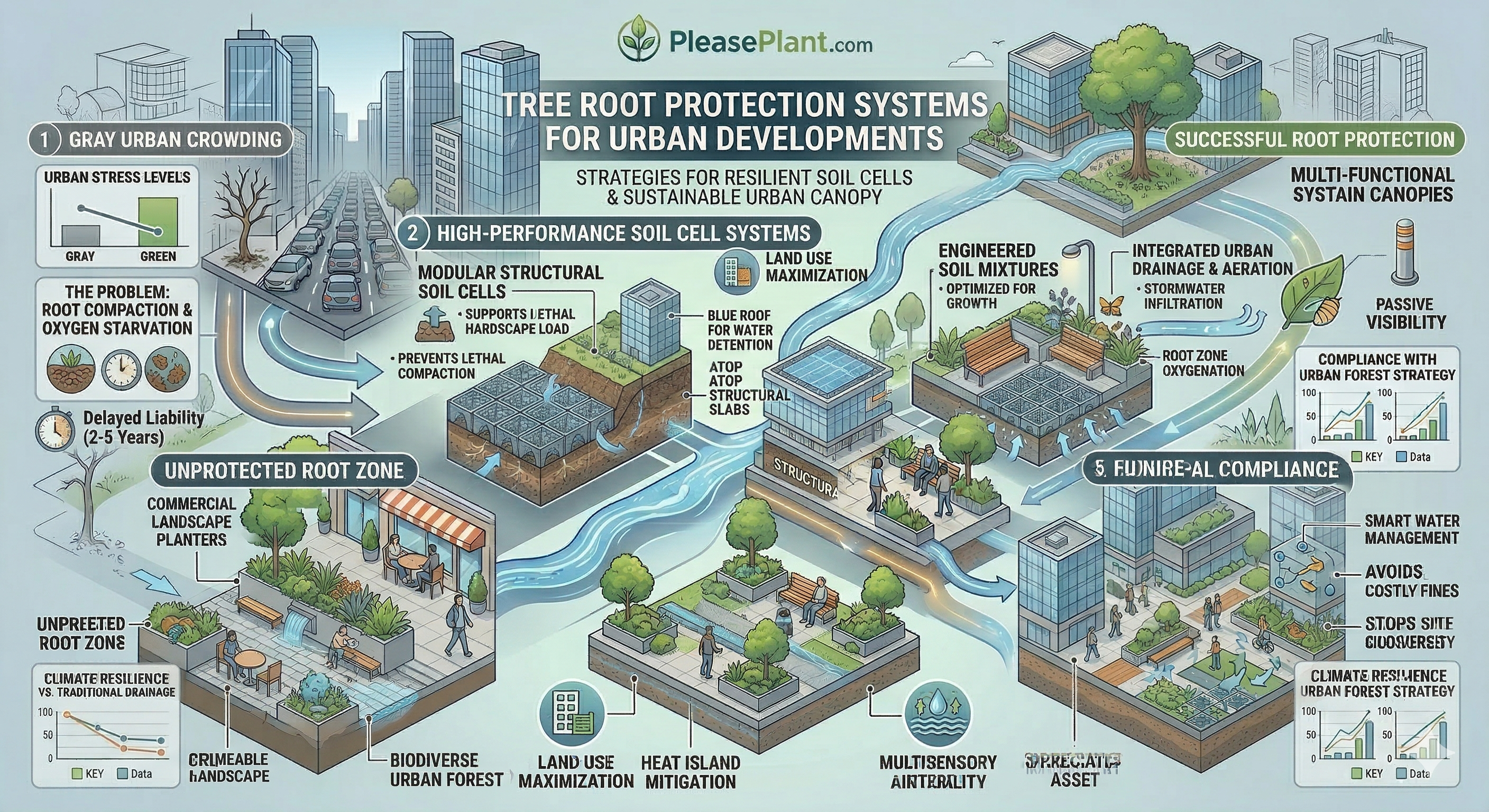
Modern root management systems are designed to end this conflict by creating a "multi-story" environment beneath the pavement. Instead of choosing between a healthy tree and a flat sidewalk, we use technology to support both.
-
Structural Soil Cells: These modular units act like a "skipping stone" for the pavement. They support the weight of vehicles and pedestrians above, while leaving the soil inside uncompacted. This gives roots the oxygen and room they need to grow down and out rather than up.
-
Root Barriers: These are physical deflectors that guide roots away from sensitive utilities and toward deeper soil layers. It’s a simple way to protect urban tree infrastructure without sacrificing the health of the tree.
-
Permeable Integration: By combining these systems with permeable surfaces, we allow rainwater to reach the roots directly. This reduces surface runoff (helping with your stormwater goals) and keeps the roots satisfied so they don't go searching for water under the concrete.
The Designer’s Perspective: Protecting the Canopy and the Curb
From a landscape architecture and planning perspective, a tree root protection system is an investment in the "finished vision" of a project. We want the lush, leafy canopy promised in the renderings, but we also want a site that doesn't fall apart in a decade.
In cities like Vancouver and Abbotsford, where "urban forest" targets are high, these systems are becoming a standard requirement. They allow us to plant larger, more impactful trees in tight urban spaces like plazas and streetscapes without the fear of future infrastructure damage.
Building a Better Foundation
Ultimately, a tree is only as good as the soil it lives in. By prioritizing root management systems early in the development process—ideally during the civil coordination phase—we can build cities that are both green and durable.
At Please Plant, we understand the technical dance between biology and engineering. Whether you’re protecting an ancient oak on a construction site or planning a new row of street trees in the Fraser Valley, we have the systems to ensure your trees and your sidewalks can finally coexist.