
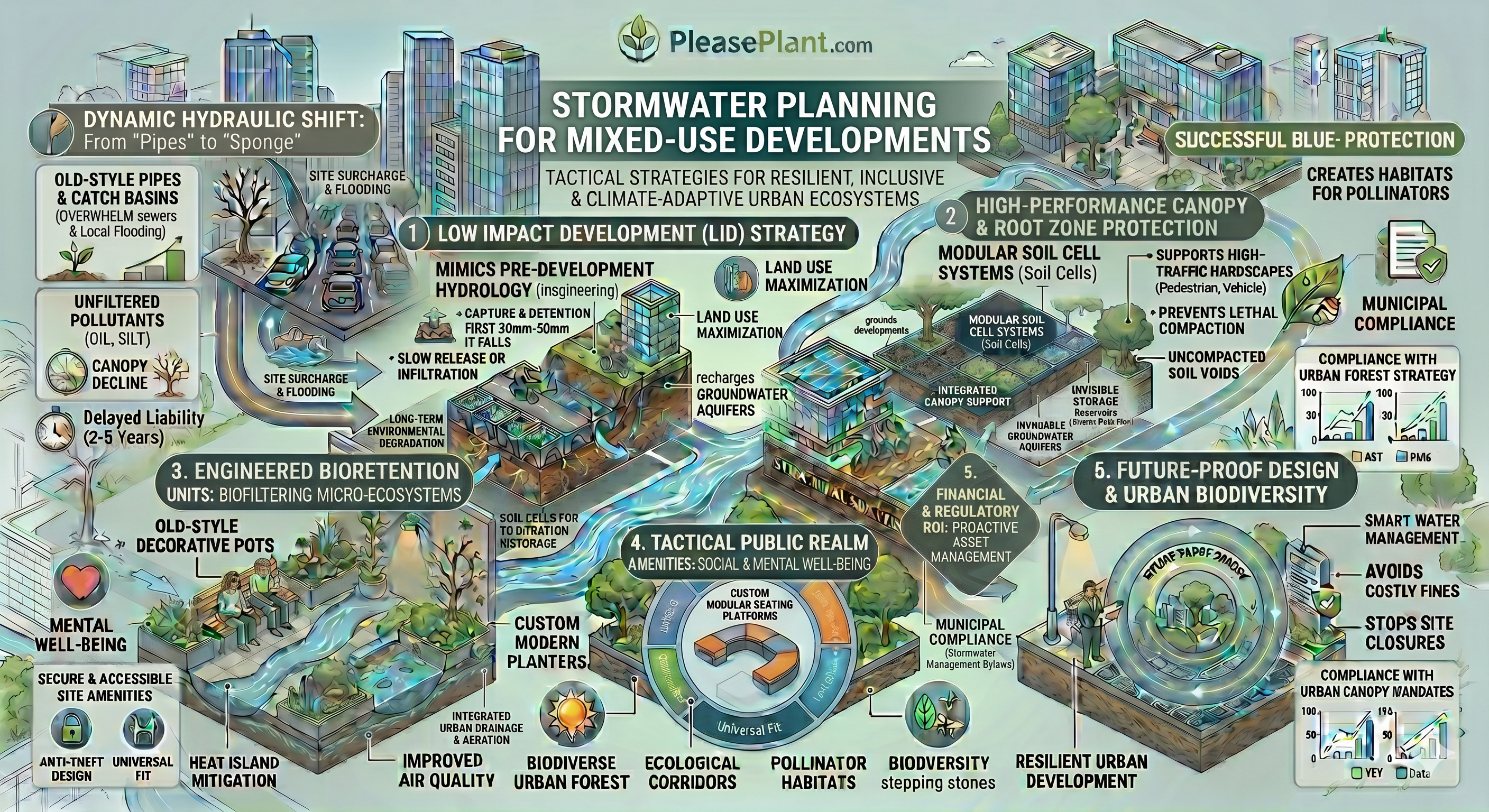
Stormwater Planning for Mixed-Use Developments
In the rapidly evolving landscape of the Fraser Valley, mixed-use developments have become
the blueprint for modern urban living. Combining residential, commercial, and often light
industrial spaces into a single site creates vibrant "live-work-play" hubs in cities like Surrey,
Langley, and Abbotsford. However, from a civil engineering perspective, these projects
represent a unique complexity. Designing mixed-use stormwater systems requires balancing
the high-volume runoff of commercial zones with the aesthetic and safety requirements of
residential living.
The Challenge of Diverse Site Needs
The primary difficulty with urban runoff control on a mixed-use site is that different zones
have different "water signatures."
• Commercial Zones: Large rooftops and high-traffic parking lots generate massive amounts of
"instant" runoff that often carries pollutants like oils and silt.
• Residential & Public Zones: These areas require "soft" landscapes, pedestrian safety, and high-
end aesthetics, meaning they cannot be dominated by industrial-looking drainage grates or open concrete ditches.
• Loading and Utility Areas: These zones often face heavy structural loads, requiring site water
infrastructure that can withstand constant truck traffic while still providing high-capacity
drainage.
Integrated Infrastructure Solutions
To manage these competing needs, developers are moving away from traditional commercial
drainage systems and toward integrated, sub-surface solutions:
1. Modular Underground Detention: Since land value is at a premium, hiding storage beneath
parking lots or shared courtyards is essential. High-strength modular cells can be configured to
fit irregular footprints, providing massive storage without taking away leasable space.
2. Zonal Treatment: Modern mixed-use stormwater systems often use a "treatment train"
approach. Runoff from parking areas is directed through oil-water separators or bioswales
before joining the cleaner runoff from residential green roofs.
3. Permeable Public Realms: By using permeable pavers in pedestrian plazas, developers can turn
the "hard" infrastructure into a "soft" drainage asset, reducing the total volume of water that
needs to be piped into the municipal grid in Chilliwack.
The ROI of Early Planning
Early-stage site water infrastructure planning is critical for mixed-use success. Because these
projects often have multiple permit requirements (both commercial and residential), a proactive
drainage strategy can significantly streamline municipal approvals. By demonstrating a
comprehensive plan for both volume control and water quality, developers can avoid the late-
stage redesigns that often plague complex, multi-use sites.
Conclusion
Mixed-use developments are the future of the Fraser Valley, but their success depends on what
happens beneath the surface. By utilizing modular, high-performance drainage solutions,
developers can create dense, vibrant communities that handle the West Coast climate with ease.
To see how our modular drainage platforms can be customized for your next mixed-use project,
contact Please Plant.