
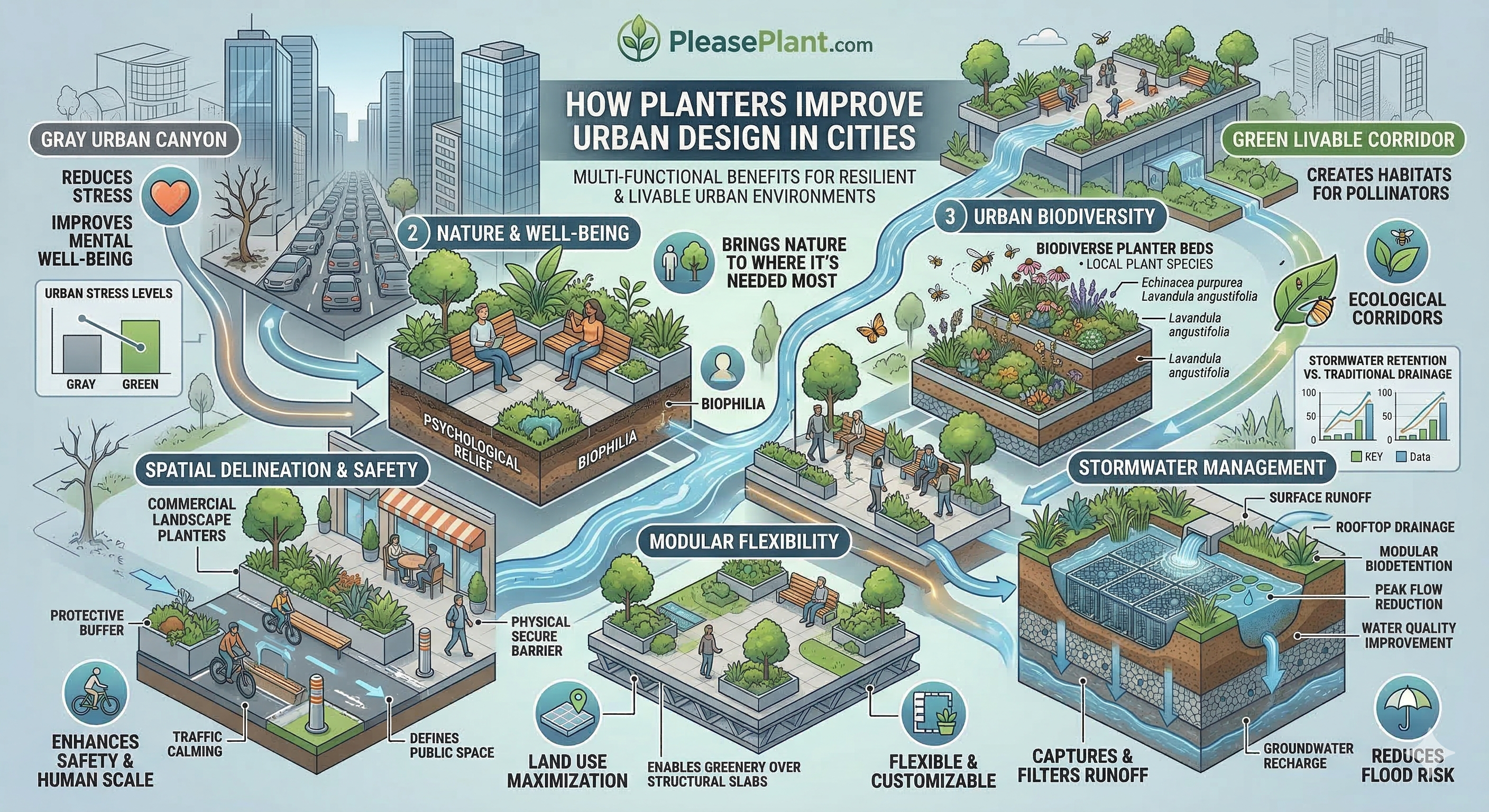
The Pulse of the Street: How Planters Are Redefining the Urban Floor
If you’ve spent any time navigating the revitalized streetscapes of Vancouver or the expanding civic plazas in Langley and Surrey, you’ve likely noticed a shift in how we experience the city. We are moving away from the sprawling, gray expanses of the past toward highly textured, human-centric environments. At the heart of this transformation is a tool that is as functional as it is aesthetic: urban landscape planters.
Anyone who has worked on a development in the Fraser Valley knows one thing: rain will always win if you ignore it. But once the drainage is sorted, the next challenge is creating a space where people actually want to linger. In dense developments across Abbotsford and Chilliwack, urban landscaping infrastructure is the key to softening the "hard" edges of our cities and turning a mere sidewalk into a destination.
Creating "Pause Points" in the Urban Rush
The real issue developers and municipal planners face is the "transit" nature of our streets. Without intervention, streetscapes become mere conduits for moving people from Point A to Point B as quickly as possible. Streetscape planters act as essential "pause points".
By strategically placing commercial planters, designers can:
-
Buffer Pedestrians from Traffic: Large-scale planters provide a physical and psychological barrier between sidewalk diners and the rush of Langley’s bypass roads.
-
Humanize the Scale of Architecture: In high-density mixed-use developments, towering glass facades can feel imposing. Urban landscape planters bring the visual focus back down to eye level, providing a sense of enclosure and comfort.
-
Encourage Social Interaction: When planters are integrated with seating—creating "planter-benches"—they naturally become hubs for community engagement and rest.
The Infrastructure of Greenery
We often think of "infrastructure" as pipes and wires, but urban landscaping infrastructure is just as critical for a healthy city. In many parts of the Fraser Valley, the ground is so crowded with utilities that planting trees directly into the soil is impossible.
Urban landscape planters solve this by providing a controlled environment for greenery to thrive. These are not just pots; they are sophisticated systems designed to:
-
Manage Urban Heat Islands: By introducing vegetation into concrete-heavy areas like Surrey’s city center, we can actually lower the local surface temperature.
-
Support Biodiversity: Even small clusters of streetscape planters can provide essential waystations for local pollinators in the middle of a dense urban grid.
-
Integrate with Stormwater: Advanced planter systems can be designed as "bioretention cells," catching sidewalk runoff and filtering it before it enters the municipal system.
The Designer’s Perspective: A Curated Streetscape
From a landscape architecture perspective, commercial planters are the "furniture" that completes the room. They allow us to curate the seasonal experience of a city—bringing the vibrant colors of spring and the structural beauty of evergreens into places that would otherwise be monochromatic gray.
In cities like Vancouver, where the "urban forest" is a major planning pillar, these planters allow us to "cheat" the constraints of the built environment. They give us the flexibility to experiment with different plant palettes and adapt the streetscape as the neighborhood evolves.
A Smart Investment in Livability
Ultimately, the presence of well-designed urban landscape planters is a signal to the public that a space is cared for. It increases the "dwell time" in retail areas—which Abbotsford and Langley developers love—and improves the overall mental well-being of city residents.
If you’re looking to transform a transit corridor into a vibrant public space, or if you need streetscape planters that can handle the rigors of the BC climate, Please Plant has the expertise to help you grow a better city.