
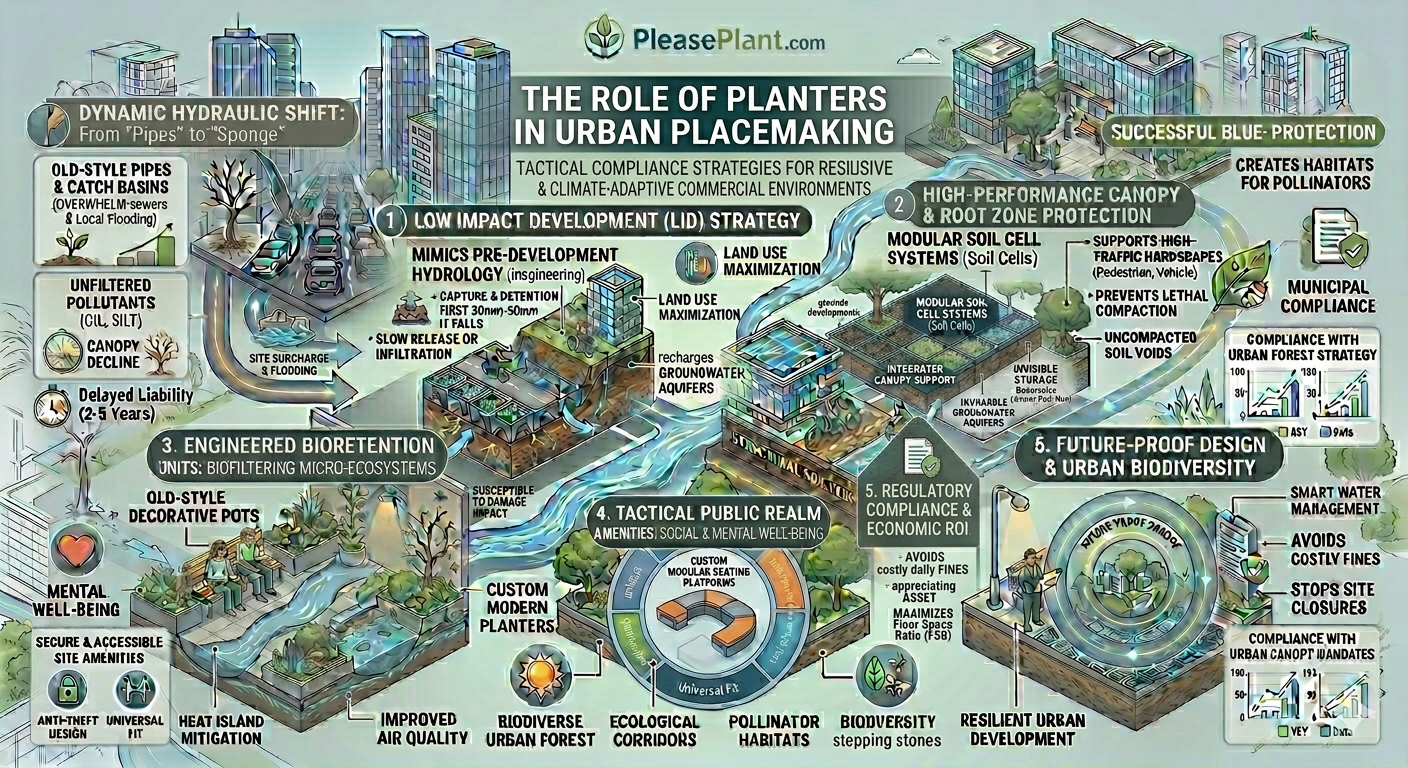
The Role of Planters in Urban Placemaking
In the architectural evolution of Vancouver, Surrey, and Burnaby, "placemaking" has become
the gold standard for successful development. It is the art of transforming a generic transit
corridor or an empty plaza into a destination where people actually want to linger. While lighting
and seating play their parts, urban planters Vancouver have emerged as one of the most
versatile tools in a designer’s kit for defining the character and flow of the modern public realm.
Defining Space and Human Scale
The primary challenge in high-density urban design is the "cavern effect"—large, glass-and-steel
towers can often feel cold and imposing at street level. Architectural planters act as a visual
bridge, bringing the scale of the environment down to a human level.
• Spatial Boundaries: Instead of using aggressive fencing or cold concrete barriers, developers use
public space planters to delineate private restaurant patios from public sidewalks.
• Traffic Calming: Strategically placed, heavy-duty planters provide a subtle, aesthetic "soft
barrier" that protects pedestrians from vehicle traffic, making the streetscape feel safer and
more enclosed.
More Than Just Greenery: Functional Infrastructure
Modern commercial landscape planters are far more than mere decorative pots. In the Fraser
Valley, they serve as critical pieces of site infrastructure:
1. Stormwater Mitigation: Large-scale planters can be engineered as "rain gardens," catching roof
or surface runoff and filtering it through specialized soil layers before it enters the city grid.
2. Microclimate Control: By introducing clusters of trees and shrubs, urban planters Vancouver
help break up wind tunnels between buildings and provide vital shade during increasingly hot BC
summers.
3. Versatile Seating: Many architectural planter systems now feature integrated wooden benches,
turning a simple garden bed into a social hub.
Aesthetic Consistency Across the Development
For developers in Abbotsford and Langley, maintaining a cohesive brand identity across a large
site is essential. Architectural planters allow for a consistent design language—whether using
sleek powder-coated aluminum for a contemporary feel or corten steel for a more industrial,
weathered look. Because these systems are often modular, they can be rearranged or expanded as
the needs of the commercial space evolve over time.
The Designer’s Perspective: Flexibility in Tight Spaces
From an A&D standpoint, the beauty of planters lies in their ability to introduce nature where in-
ground planting is structurally impossible. Whether it’s a rooftop terrace in downtown
Vancouver or a plaza situated directly over a parking garage, urban planters Vancouver allow
for lush, mature landscapes without the need for deep excavation.
Conclusion
Placemaking is about the details that make a space feel "owned" by the community. By investing
in high-quality public space planters, developers create environments that are not only more
beautiful but more functional, safe, and resilient.
To see how our range of architectural and commercial planters can transform your next urban
project, contact Please Plant.