
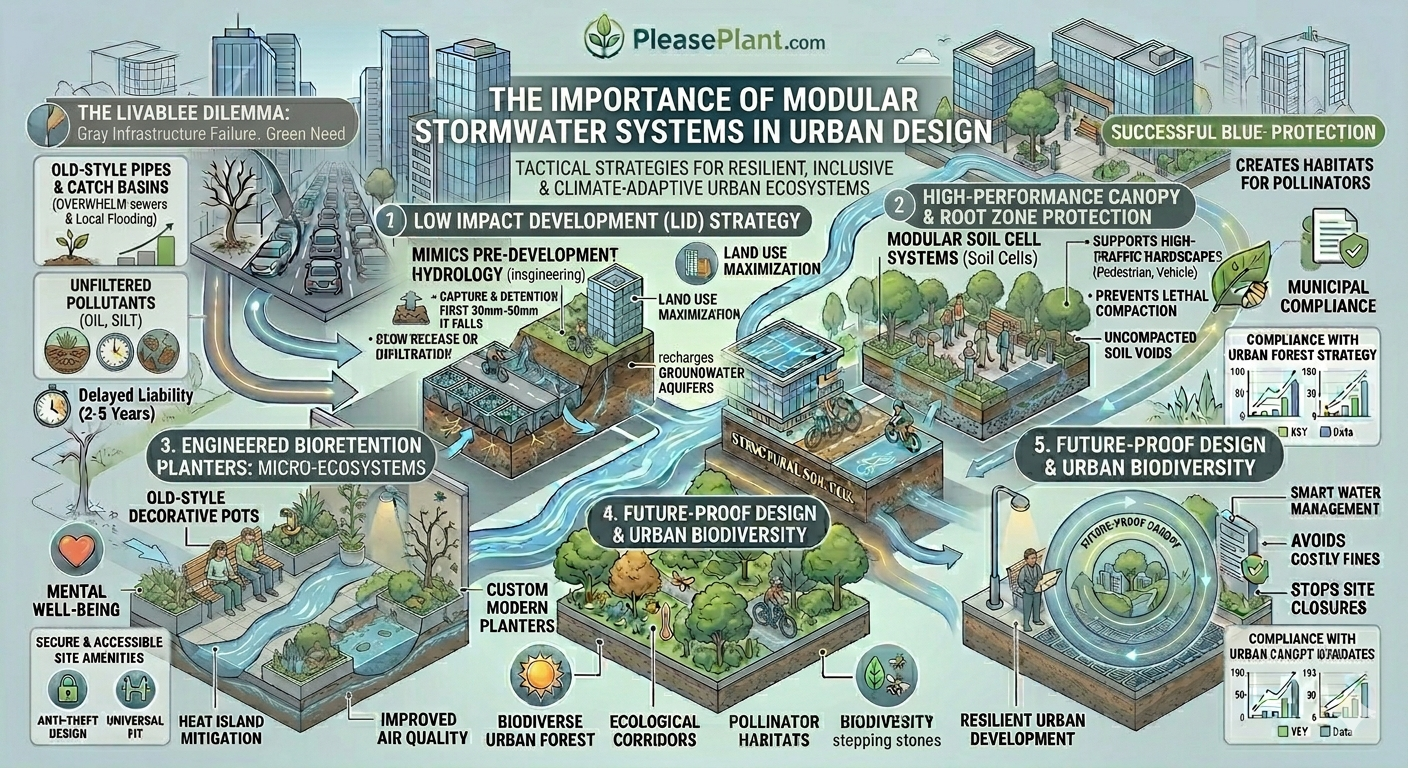
The Importance of Modular Stormwater Systems in Urban Design
If you’ve ever looked at a grading plan for a high-density project in Surrey or Langley and felt a slight headache coming on, you aren’t alone. Designing for the Fraser Valley means playing a high-stakes game of "Where does the water go?" on sites that are increasingly crowded and complex. This is why modular stormwater systems have moved from being a niche engineering choice to the backbone of modern urban drainage infrastructure.
Anyone who has worked on a development in the Fraser Valley knows one thing: rain will always win if you ignore it. As we push for more density in Abbotsford and Chilliwack, the "old school" method of massive concrete tanks or open ponds is becoming a relic of the past.
The Complexity of the Modern Urban Site
The real issue developers face today is the lack of "easy" space. Between underground utilities, required parking ratios, and tree protection zones, finding room for traditional drainage is a nightmare. Modular drainage systems solve this by being the ultimate "shape-shifters" of the civil world.
Why "Modular" is the New "Standard"
Unlike a rigid, one-size-fits-all concrete bunker, stormwater cell systems offer a level of flexibility that designers love:
-
Design Agility: These systems can be configured as long, narrow galleries, L-shapes, or even wrapped around existing columns and utility lines.
-
Rapid Installation: Because they are lightweight and stackable, a small crew can install a massive detention system in a fraction of the time it takes to pour concrete.
-
Maintenance Simplified: Modern modular units often include integrated inspection and clean-out ports, ensuring the system performs at peak capacity for decades.
-
High Performance: With a void ratio often exceeding 95%, you get maximum storage in the smallest possible footprint.
The Designer’s Perspective
From a landscape architecture planning perspective, the beauty of modular stormwater systems is that they stay out of sight. We can bury them under plazas, parking lots, or even fire access lanes, allowing us to use the surface for what really matters: pedestrian amenities and green space. It allows the engineering to support the design, rather than dictate it.
Conclusion
As the Fraser Valley continues its rapid transformation, we need infrastructure that is as adaptable as our cities. Modular systems provide the scalability and performance required to build smarter, more resilient developments.
To see how modular platforms can simplify your next complex site design, contact Please Plant.