
The Great Water Debate: Stormwater Detention vs. Retention Systems Explained
If you’ve ever sat through a coordination meeting for a new development in the Fraser Valley, you’ve likely heard the civil engineer and the landscape architect go back and forth on "the pond." One calls it a detention basin; the other calls it a retention pond. To the untrained ear, it sounds like splitting hairs. But in the world of stormwater design, the difference between these two is the difference between a dry field and a permanent lake—and it has massive implications for your site plan.
Anyone who has worked on a development in the Fraser Valley knows one thing: rain will always win if you ignore it. In regions like Abbotsford, Langley, and Chilliwack, where development is moving at a breakneck pace, how we handle that rain determines whether a project is a success or a drainage disaster.
The Problem: When the Sky Opens Up
The real issue developers face in the Fraser Valley is that our natural landscapes are being replaced by "impervious" lids—think rooftops, asphalt, and concrete. Before we built on them, these sites acted like sponges. Now, they act like slides. Without proper urban drainage infrastructure, a heavy BC downpour can overwhelm municipal systems, flood neighboring properties, and wash away expensive landscaping.
To prevent this, municipal planners require developers to prove they can manage their own runoff. This usually leads to a choice between two primary stormwater design strategies: detention or retention.
Stormwater Detention Systems: The Temporary Waiting Room
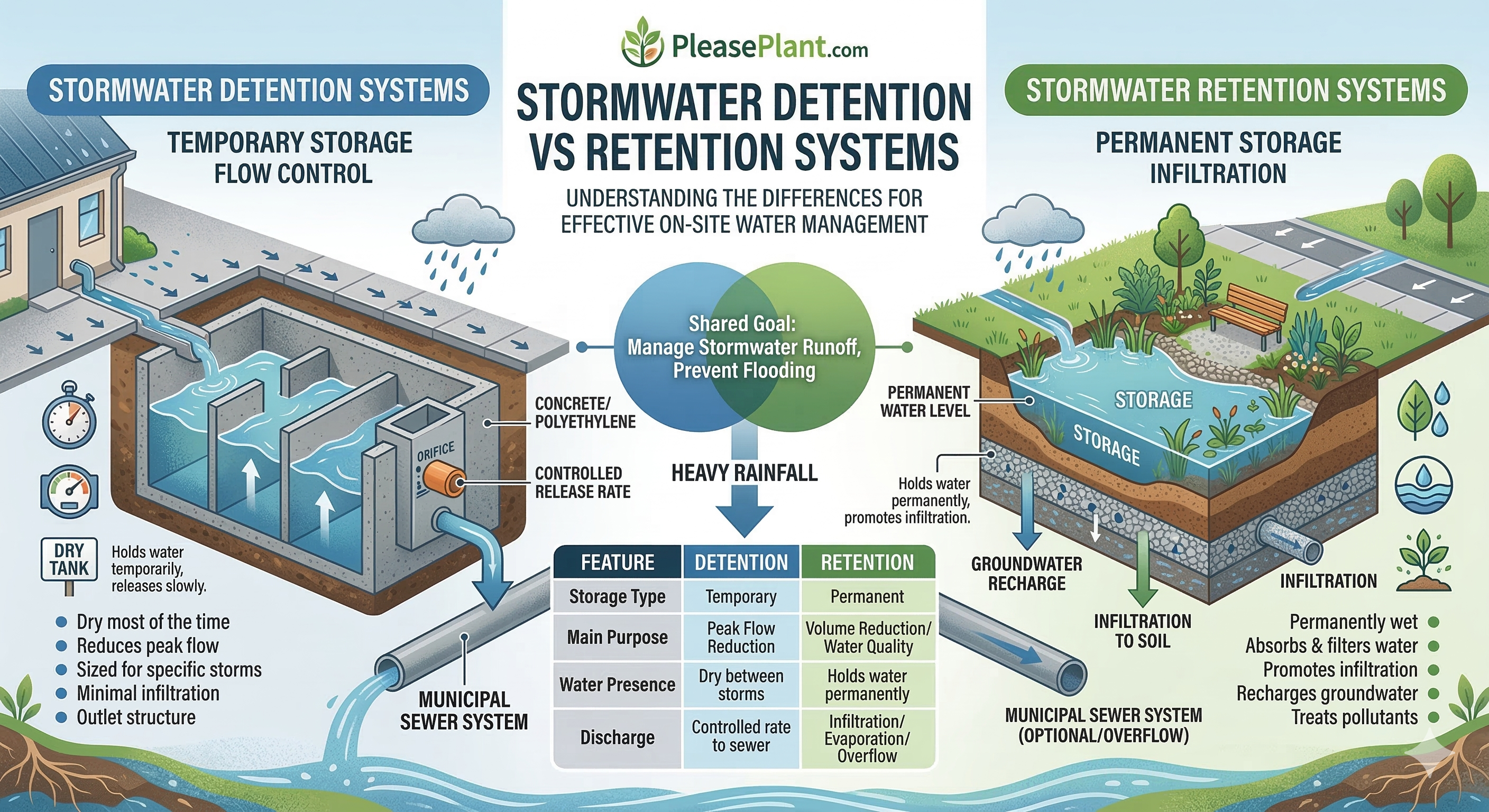
Think of stormwater detention systems as a temporary holding tank for a busy restaurant. When a massive storm hits, the system "catches" the water and holds it. It then releases that water at a slow, controlled rate into the municipal storm sewer once the peak of the storm has passed.
-
How it looks: In many cases, these are "dry" ponds that only fill up during a storm and remain empty (or just slightly damp) the rest of the time.
-
The Modern Twist: For commercial developments where land is at a premium, developers are increasingly moving away from surface ponds and toward underground stormwater detention systems. Using modular stormwater cells, we can hide the "waiting room" directly under a parking lot or a courtyard.
Stormwater Retention Systems: The Permanent Guest
While detention is about "slowing it down," retention is about "keeping it there." A retention system is designed to hold a specific volume of water permanently. The only way water leaves a retention system is through evaporation or, more commonly, by soaking back into the ground—a process called infiltration.
-
How it looks: These are often "wet" ponds or constructed wetlands that maintain a certain water level year-round
-
The Benefit: Retention is excellent for water quality because the soil and plants act as natural filters, cleaning the runoff before it hits the groundwater.
Which One Should You Use?
Deciding between these systems usually comes down to three things: municipal requirements, soil conditions, and site space.
-
Soil Conditions: In parts of Langley or Surrey with heavy clay, retention can be tricky because the water won't soak in fast enough. Detention is often the safer bet here.
-
Land Value: If you’re building high-density residential in Abbotsford, you probably don’t want to lose three units of housing to a permanent pond. Underground stormwater detention systems allow you to maximize your buildable area.
-
Environmental Goals: If your project is aiming for high sustainability marks or LEED certification, retention and infiltration systems are often preferred because they mimic natural water cycles.
The Design Perspective
As designers and planners, we have to look past the engineering and think about how these systems integrate with the urban fabric. A detention system doesn't have to be a fenced-off hole in the ground. It can be a sunken plaza that doubles as a public space 95% of the year.
By choosing the right stormwater design, we aren't just checking a box for a municipal permit. We are building infrastructure that protects the development and the community from the unpredictable BC weather.
Moving Forward
Whether you need a massive underground detention tank or a series of bio-retention planters, the goal remains the same: manage the water so it doesn't manage you.
If you're looking to optimize your site's urban drainage infrastructure without sacrificing your design vision, Please Plant can help you navigate the nuances of these systems. We specialize in finding the "sweet spot" where engineering requirements meet beautiful, functional landscape design.