
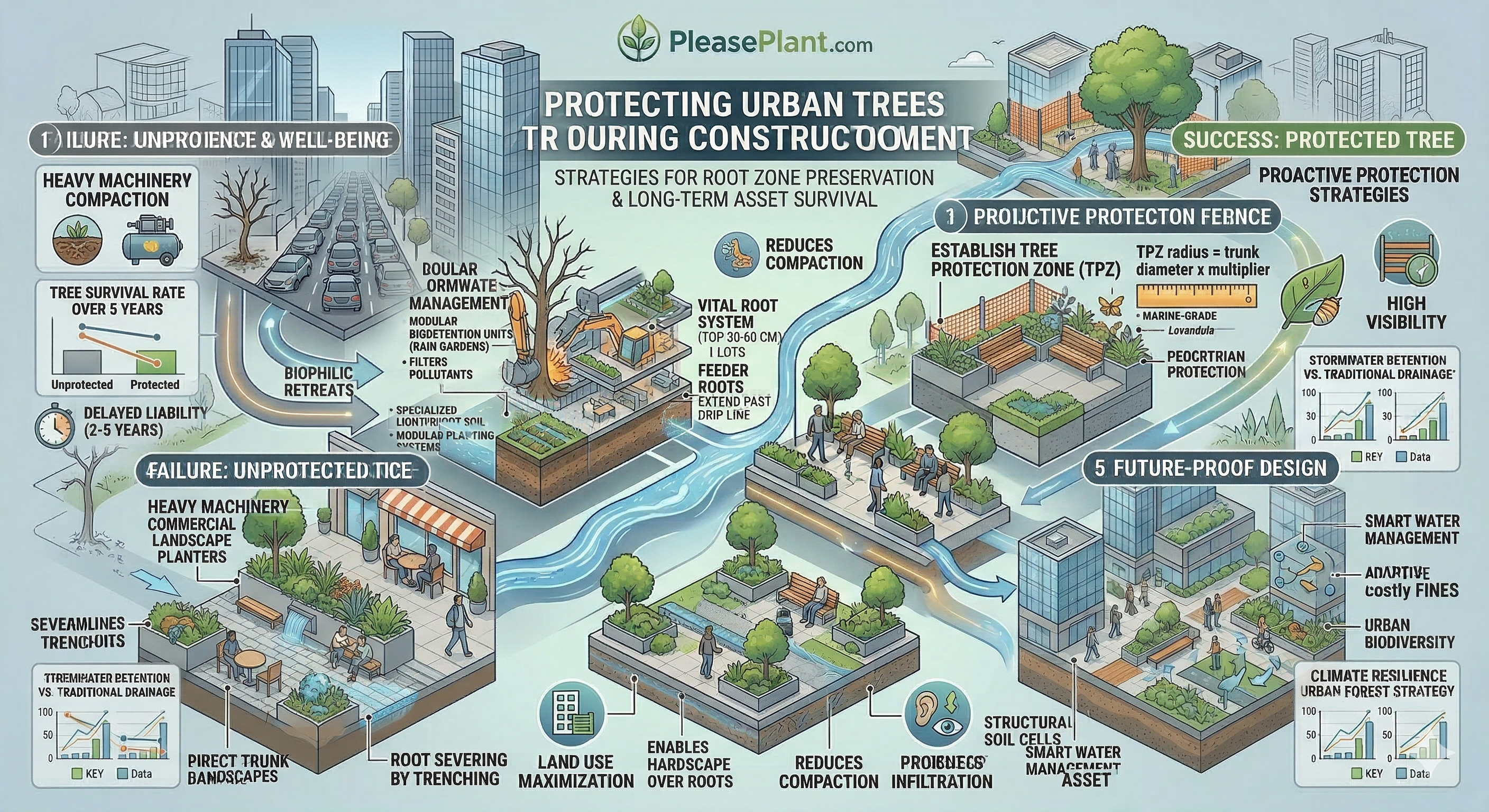
The Silent Casualties: Why We Need to Stop "Accidental" Tree Loss on the Job Site
If you’ve ever walked onto a mid-stage construction site in the Fraser Valley—maybe a new townhome block in Langley or a commercial infill in Abbotsford—you’ve likely seen the bright orange snow fencing. It’s often leaning precariously, half-crushed by a stray piece of rebar or a stack of pallets. In the industry, we call that a "suggestion of protection." But for the long-term health of our urban tree protection efforts, a flimsy plastic fence is rarely enough.
Anyone who has worked on a development in the Fraser Valley knows one thing: rain will always win if you ignore it. But the second truth is that trees will always lose if we don’t design for them. As we densify our cities from Surrey to Chilliwack, we are building closer than ever to existing canopies. Without professional-grade tree protection systems, we aren't just risking a municipal fine; we are risking the death of the very assets that make our developments valuable and "green."
The Problem: Why Construction is Hard on Roots
The real issue developers face during construction tree protection isn't just the obvious danger of a bobcat hitting a trunk. The real "silent killer" of urban trees is soil compaction. In the Fraser Valley, our heavy rains turn construction sites into mud pits, and the constant traffic of heavy machinery squeezes the air and water pockets out of the soil.
When soil is compacted:
-
Roots can’t breathe: Roots need oxygen as much as they need water.
-
Water can’t penetrate: Instead of soaking in, rainwater becomes runoff, starving the tree and contributing to site drainage issues.
-
Structural damage occurs: Direct excavation for utilities often severs critical anchor roots, making a tree a high-risk liability once the wind picks up in November.
Why Municipalities are Cracking Down
Across British Columbia, municipalities are tightening the screws on tree bylaws. In places like Vancouver and Abbotsford, an "accidental" loss of a protected tree can lead to stop-work orders and massive financial penalties. Modern urban tree protection is now a mandatory part of the permitting process, requiring a certified arborist to sign off on a protection plan before the first excavator even arrives.
Modern Tree Protection Systems that Actually Work
We’ve moved past the era of the orange fence. High-performance tree protection systems today focus on the "Root Protection Zone" (RPZ).
-
Modular Ground Protection: Instead of letting trucks drive over bare earth, we use structural soil cells or heavy-duty temporary mats that distribute the weight of the machinery, preventing the soil from compacting around sensitive roots.
-
Tree Root Protection Systems (Structural Soil): For new plantings, we are increasingly using modular systems that provide a "skipping stone" structure for pavement to sit on, allowing uncompacted soil to remain underneath for roots to grow freely.
-
Rigid Fencing and Hoarding: Professional sites are moving toward rigid, plywood hoarding or steel fencing that can't be pushed back "just a few feet" to make room for a shipping container.
The Designer’s Perspective: Protecting the Finished Vision
From a landscape architecture and planning perspective, protecting trees during construction is about protecting the "finished product." A mature tree provides an immediate sense of "place" that takes thirty years to replicate with new plantings. When we integrate tree root protection into our site planning, we ensure the project looks like the rendering on day one—not ten years later.
It influences everything from where the civil team runs the storm pipes to how the developer stages their materials. It’s about viewing the tree as a piece of essential infrastructure, not just an obstacle.
Designing for Longevity
At the end of the day, a tree that survives construction but dies three years later because its roots were crushed is a failure of design and execution. By using the right tree protection systems and prioritizing urban tree protection, we build developments that are truly sustainable.
If you're looking to protect the natural assets on your next Fraser Valley project, Please Plant can help you navigate the technical side of root protection and soil health. Let’s make sure the only thing you’re breaking on your next site is ground—not the environment.