
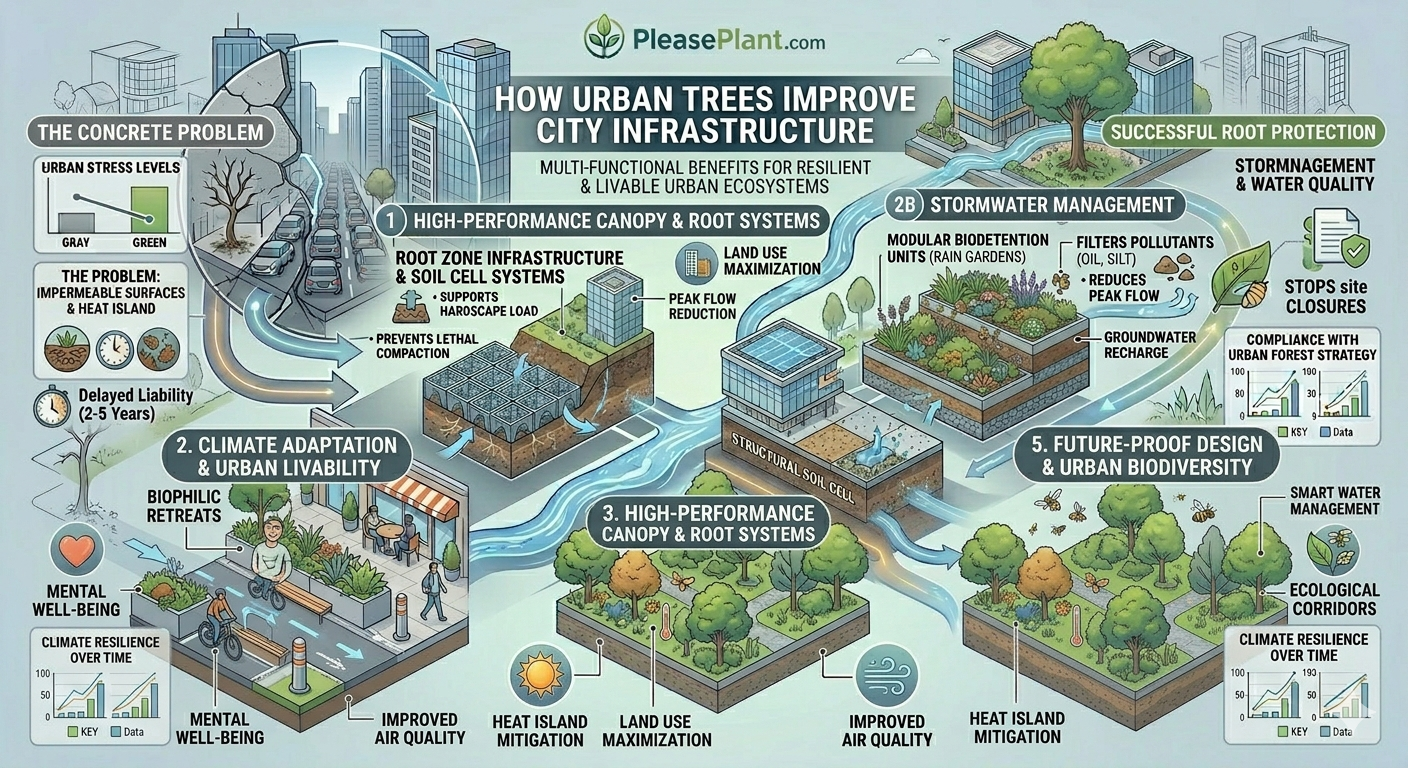
The Hard-Working Canopy: Why Urban Trees Are the Most Efficient Infrastructure We Own
If you’ve ever ducked under a leafy maple in downtown Vancouver during a July heatwave, or noticed how the air feels just a bit crisper in the treelined streets of Abbotsford, you’ve experienced urban tree infrastructure in action. In the design world, we often talk about infrastructure in terms of concrete, steel, and fiber optics, but some of our most powerful municipal assets are actually alive.
Anyone who has worked on a development in the Fraser Valley knows one thing: rain will always win if you ignore it. However, we’re starting to realize that the "green" on our sites—specifically our trees—does more than just look good in a sales brochure. As we densify our communities from Langley to Chilliwack, urban forestry is becoming a critical tool for building cities that can actually handle the environmental pressures of the 21st century.
The Living Sponge: Trees and Stormwater
The real issue developers face with stormwater, runoff, and drainage is the sheer volume of water that hits our paved surfaces during a typical BC downpour. This is where urban tree infrastructure proves its worth as a high-performance drainage tool.
Trees improve our green infrastructure through a process called "interception". Before a single drop of rain hits the ground, the leaf canopy catches it, slowing its descent and allowing some of it to evaporate directly back into the atmosphere. Once the water does reach the ground, the root systems act like biological pumps, drawing moisture out of the soil and creating "void space" for the next rainfall. By integrating trees into our site planning, we reduce the peak flow entering our municipal pipes, which is a major win for sustainable development.
Natural Air Conditioning: The Cooling Effect
In the Fraser Valley, our summers are getting hotter, and our "urban heat islands"—those pockets of concrete that trap and radiate heat—are becoming a major concern for planners. Trees are our most effective cooling technology.
Through transpiration (essentially tree "sweat") and providing direct shade, a healthy urban canopy can lower surface temperatures in a plaza or parking lot by as much as 10°C to 20°C. This doesn't just make the space more comfortable for pedestrians in Surrey or Langley; it actually reduces the energy load on the surrounding buildings.
Cleaning the Air We Breathe
Beyond water and heat, urban forestry acts as the city’s lungs. Trees are incredibly efficient at filtering the air in our dense urban corridors. Their leaves trap particulate matter from vehicle exhaust and absorb pollutants like nitrogen dioxide and sulfur dioxide. For developers, including robust urban tree infrastructure isn't just an aesthetic choice; it’s a commitment to the health and air quality of the future residents.
The Designer’s Perspective: Scaling the Canopy
From a landscape architecture and planning perspective, we are moving away from treating trees as "decor" and toward treating them as a core utility. This means shifting our focus to:
-
Soil Volume: Ensuring trees have the uncompacted soil they need to reach their full biological potential.
-
Species Diversity: Planting a resilient mix of trees that can withstand the specific climate shifts we’re seeing in British Columbia.
-
Structural Integration: Using root management systems to allow trees to grow large and impactful without damaging our sidewalks and pipes.
Building a More Resilient BC
Ultimately, the value of a tree increases as it ages. By protecting our existing canopy and investing in new urban tree infrastructure, we are building a more resilient, livable, and breathable Fraser Valley.
At Please Plant, we specialize in the systems that make this possible—from structural soils to root protection—ensuring that your urban trees can do the hard work of improving our city infrastructure for generations to come.