
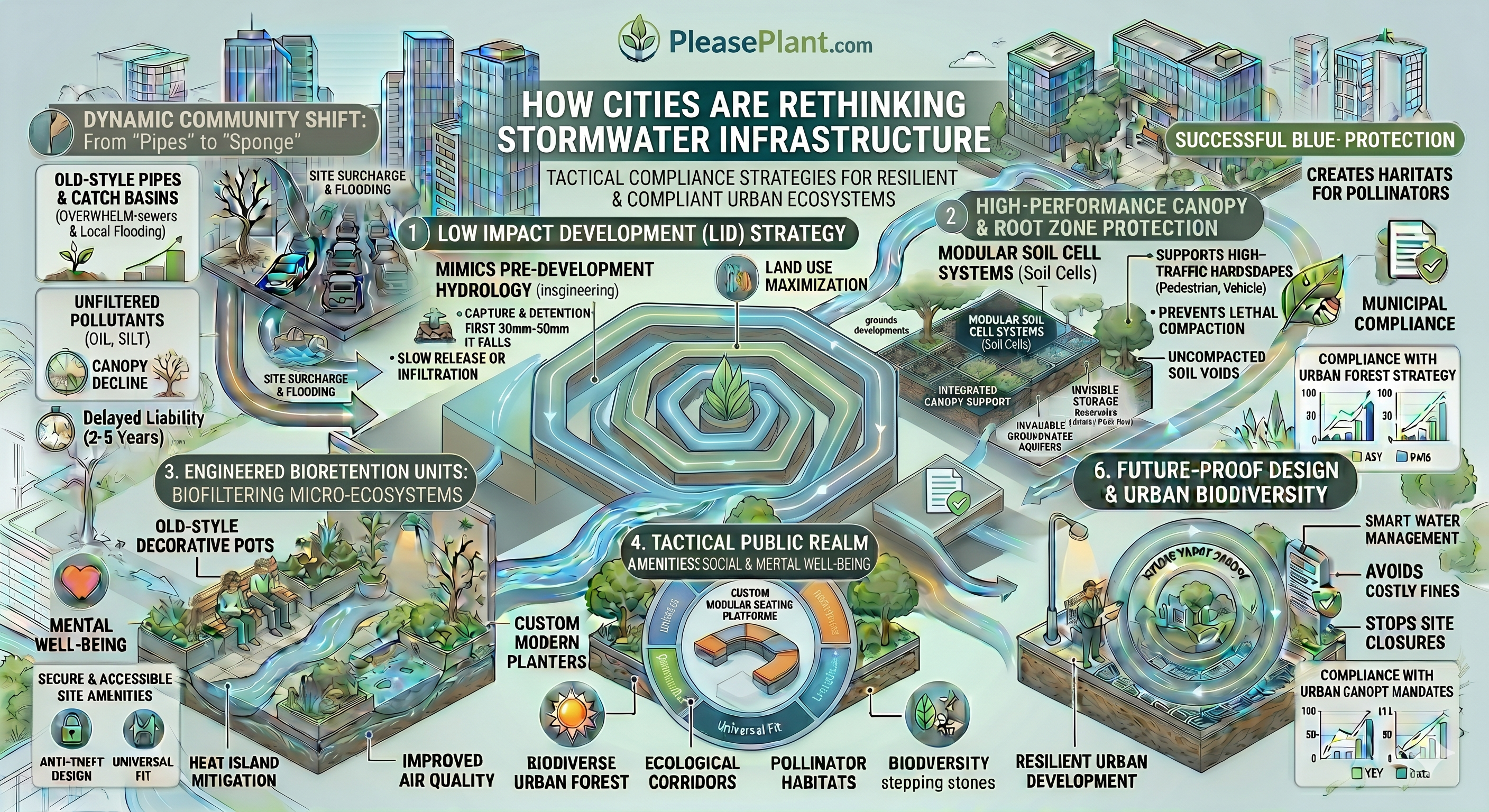
How Cities Are Rethinking Stormwater Infrastructure
For decades, the "out of sight, out of mind" approach to stormwater infrastructure Vancouver
and the surrounding Fraser Valley was the gold standard. Rain fell, hit a catch basin, and
disappeared into a vast network of underground pipes. However, as the 2026 climate reality sets
in—marked by more frequent atmospheric rivers and rapid urban densification—the "pipe-it-
away" model is being fundamentally re-engineered. Municipalities from Surrey to Abbotsford
are shifting toward a more integrated, resilient, and "visible" approach to urban water
infrastructure.
From Gray to Green: The Hybrid Model
The real issue cities face today is that traditional city stormwater systems are being
overwhelmed. As we add more rooftops and pavement, we lose the natural ability of the land to absorb water. To address this, municipal drainage planning is moving away from purely "gray"
infrastructure (pipes and concrete) and embracing a hybrid "green" model:
• Sponge City Principles: Cities are requiring developments to act as sponges, absorbing a specific
volume of rainfall on-site before it ever touches the municipal grid.
• Integrated Management: Rather than one large pipe, municipalities are utilizing a decentralized
network of bioswales, rain gardens, and permeable public plazas.
• Source Control: Modern standards now mandate that new developments manage the "first
flush" of a storm, which is often the most polluted, through natural filtration layers.
Updating the Standards
In hubs like Langley and Chilliwack, the bar for stormwater infrastructure Vancouver has
been raised. Engineers are no longer designing for historical averages; they are designing for
future extremes.
1. Low Impact Development (LID): Many municipalities now require LID techniques as a condition
of permit approval, forcing a move toward permeable surfaces and modular underground
storage.
2. Volumetric Requirements: New bylaws often specify that a site must be able to retain and
slowly release the rainfall from a 1-in-10-year or even a 1-in-100-year storm event.
3. Water Quality Targets: There is a growing focus on removing oils, silt, and heavy metals from
urban water infrastructure before it reaches the Fraser River and local salmon-bearing streams.
The Role of Technology and Modularity
To meet these strict new standards on cramped urban sites, developers are turning to high-
performance modular solutions. Modular stormwater cells allow for massive amounts of storage
to be hidden beneath parking lots or parks, providing the necessary detention volume without
requiring additional land. These systems are easier to maintain and can be scaled as a project
grows, making them a favorite in modern municipal drainage planning.
Conclusion
Cities are no longer just building drains; they are building ecosystems. By rethinking
stormwater infrastructure Vancouver, we are creating urban environments that are not only
drier and safer but also greener and more sustainable for the long term.
To see how our modular drainage and stormwater solutions can help your project meet the latest
municipal standards, contact Please Plant.