
The New Room Dividers: Why Architectural Planters are the Secret Weapon of Modern Site Design
If you’ve spent any time lately in the newly minted public plazas of Vancouver or the emerging mixed-use corridors in Langley, you’ve seen them: massive, clean-lined vessels that seem to do much more than just hold a tree. We’ve officially moved past the era where a pot was just a decorative afterthought. In the current A&D climate, architectural planters have become a fundamental building block of the urban floor.
Anyone who has worked on a development in the Fraser Valley knows one thing: rain will always win if you ignore it, but the second thing they know is that hardscaping can feel incredibly cold without a strategic green intervention. As we densify our commercial cores in Abbotsford, Surrey, and Chilliwack, we are increasingly relying on urban planter systems to bring a human scale back to the concrete jungle.
The Planter as a Spatial Tool
The real issue developers and designers face in modern urban environments is how to define space without building permanent, restrictive walls. This is where architectural planters shine as a spatial tool. Landscape architects are increasingly using them to:
-
Define Pedestrian Flow: By staggering commercial outdoor planters, we can intuitively guide foot traffic through a plaza or toward a retail entrance.
-
Create Outdoor "Rooms": Planters act as soft barriers, carving out intimate seating areas or dining "pockets" within a large, sprawling commercial development.
-
Safety and Security: In an age where hostile vehicle mitigation is a reality of urban design, heavy-duty landscape planters serve as a beautiful, non-aggressive way to protect pedestrian zones.
Beyond the Box: High-Performance Urban Planter Systems
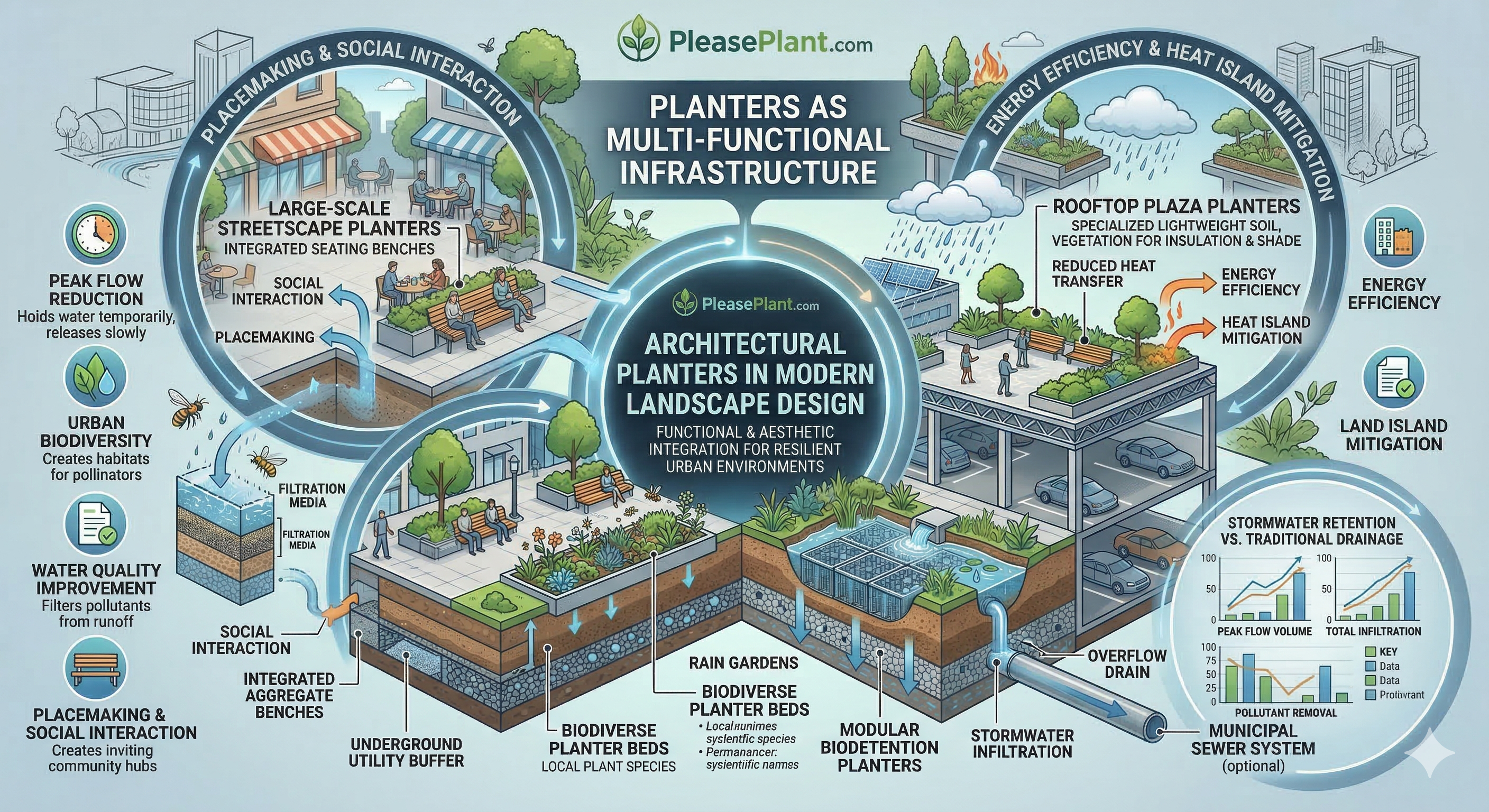
Today’s architectural planters are no longer just "pots"; they are integrated pieces of urban planter systems. For a project in the Fraser Valley, where drainage is always a top-tier concern, these systems have to be as functional as they are aesthetic.
Modern commercial outdoor planters often feature:
-
Internal Reservoir Systems: To manage BC’s fluctuating moisture levels and reduce maintenance costs.
-
Integrated Lighting: Transforming a simple planter into a glowing beacon that defines a space after dark.
-
Custom Materiality: Whether it’s powder-coated aluminum to match a facade or fiberglass for lightweight rooftop applications, the material choice is as much about the architecture as the plant life.
The Designer’s Perspective: Softening the Edge
From a landscape architecture standpoint, landscape planters are the "furniture" that completes the room. They allow us to introduce greenery—and the psychological benefits that come with it—onto sites where traditional in-ground planting is impossible due to underground utilities or parking structures.
In cities like Vancouver and Abbotsford, where the "urban forest" is a key planning pillar, these planters allow us to "cheat" the concrete, bringing lush, layered planting into high-density environments. It’s about creating a sense of place that feels intentional, curated, and alive.
A Smart Investment in Public Life
At the end of the day, choosing high-quality architectural planters is an investment in the "vibe" and longevity of a development. They are the tactile elements that people sit next to, lean against, and walk past every day. When we get the scale and the placement right, we transform a transition space into a destination.
If you’re looking to elevate the streetscape of your next commercial project or looking for urban planter systems that can withstand the rigors of the Fraser Valley, Please Plant has the architectural solutions to help you define your space with style.